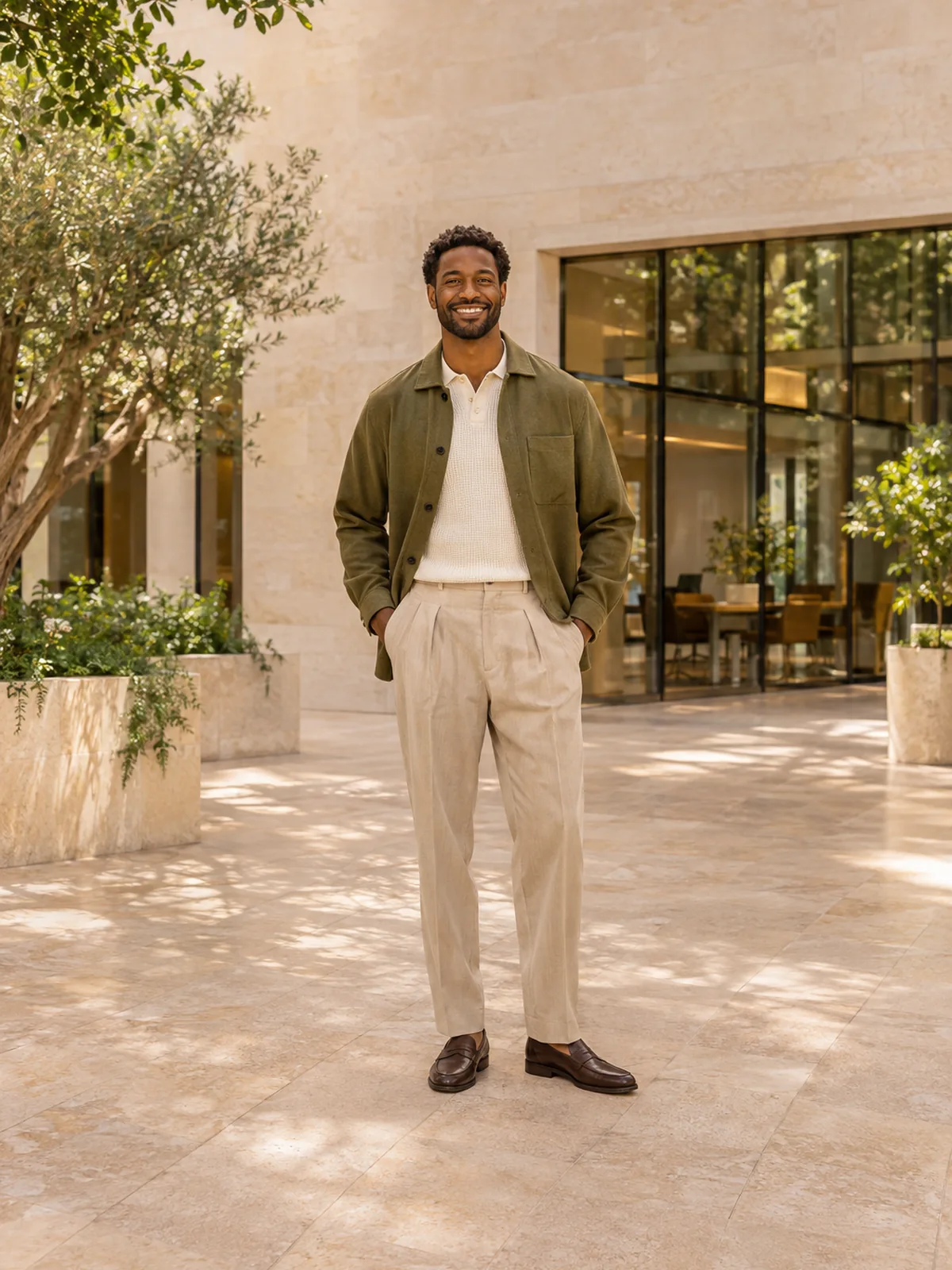
Business casual outfits for men usually start with neat trousers or chinos, a collared shirt or refined knit, and clean shoes appropriate to the workplace. The exact boundary varies: some offices welcome dark jeans and minimal sneakers, while others expect tailored trousers and leather shoes. Use the dress policy and the day's activities to choose your level.
This guide may contain affiliate links. As an Amazon Associate we earn from qualifying purchases. How our links work.
What does business casual actually mean in your office?
Business casual is not a universal garment list. It describes a level of workplace dress that sits below a conventional suit but still looks considered. A software office, a client-facing consultancy, and a school can all use the phrase differently. Start with the written policy, role-specific safety needs, and what colleagues wear for comparable duties.
For a first day with little information, choose a collared shirt, tailored-looking trousers or chinos, and clean, understated shoes. Bring a simple jacket or fine-gauge knit if the weather and workplace suit it. This gives you room to adjust without assuming that a T-shirt and trainers are accepted everywhere.
Think about the day's most formal interaction, not just the commute. A normal desk day may allow a polo, while a presentation could call for a shirt and jacket. Our men's style guides focus on repeatable combinations; one useful adjustment can be more effective than maintaining separate wardrobes for every possible office situation.
Which three outfit formulas cover most ordinary days?
For a reliable starting point, pair navy chinos with a pale blue button-down shirt and brown loafers or plain lace-up shoes. Tuck the shirt if its length and the office norm call for it. This combination has enough contrast to look deliberate without relying on a tie or a matching suit jacket.
For a knitwear-led version, wear charcoal trousers with a fine-gauge crewneck over a neat collared shirt, plus dark derbies or another accepted shoe. Check that the shirt does not bunch beneath the knit. A sweater that skims rather than grips the torso usually makes layering easier, but fit preferences and body shapes differ.
For a more relaxed office, try olive chinos with a solid polo and minimal leather or canvas sneakers only if sneakers are permitted. Choose a polo that holds its shape and trousers without distressing. These are starting points, not required purchases; similar pieces you already own can create the same level of formality.
How should shirts and trousers fit?
Check movement before judging a still photograph. Button the shirt, reach forward as if using a keyboard, and sit down. Look for pulling between buttons, a collar that feels restrictive, or cuffs that interfere with your hands. A shirt can be intentionally relaxed without being so oversized that it catches on everything or needs constant retucking.
Try trousers with the shoes you plan to wear. The waistband should stay comfortable when seated, and pockets should not flare simply because the seat or thighs are too tight. A shorter hem can look clean, but there is no need to expose the ankle if you dislike it or the workplace is more conservative.
If trousers fit through the hips and thighs but bunch excessively at the shoes, hemming may be worth considering. Do not size down the whole garment just to shorten the leg. Likewise, a jacket that pulls across the chest is not fixed by leaving it permanently open. Fit problems are easier to spot when you move and sit, not just when you stand squarely.
Are jeans and sneakers business casual?
Sometimes, but neither is automatically included. If jeans are allowed, dark or even-toned denim without rips is often easier to integrate into a restrained office outfit than heavily distressed styles. Pair it with a collared shirt, neat knit, or unstructured jacket so the whole outfit reads as workwear rather than a weekend default.
Sneakers should follow the office's actual policy. A simple, clean pair can work in a relaxed environment, but a minimalist design does not override a rule requiring other footwear. Check whether client meetings or particular locations have different expectations. In workplaces with protective-footwear requirements, safety comes first; a fashion shoe is not a substitute.
If white sneakers are part of your accepted rotation, use our guide to cleaning white sneakers before they become visibly grubby. Follow the shoe manufacturer's care guidance and avoid assuming every material tolerates soaking or machine washing. A clean, slightly worn shoe often looks more presentable than a new pair that hurts and changes how you walk.
How do you add a jacket without looking overdressed?
Choose a jacket that works separately from a suit, such as an unstructured blazer in a restrained color or texture. Pair navy with gray or olive trousers rather than trying to match two almost-identical navies. A deliberate contrast usually looks clearer than an accidental near-match, particularly when fabrics differ.
Keep the rest of the outfit simple. A pale shirt, plain trousers, and uncomplicated shoes give the jacket a useful role. A pocket square, tie bar, patterned belt, and statement socks are not all necessary. If your office is very relaxed, a clean overshirt may be more appropriate than a blazer, provided it still meets the dress expectations.
The jacket should let you sit and reach comfortably, even if you remove it at your desk. Check shoulder placement, sleeve length, and whether the front pulls when fastened. Do not buy an expensive-looking label in place of a workable fit. There is no brand requirement for looking appropriately dressed at work.
What changes in hot or cold weather?
In warm weather, look at fabric weight, weave, and how the garment feels on your body. Lightweight cotton, linen blends, or other suitable fabrics can make sense, but fiber names alone do not guarantee comfort. A dense fabric can feel warm regardless of its marketing description. Check whether the shirt remains suitably opaque in daylight.
A short-sleeved collared shirt or a neat polo may work where the policy permits it. If shorts are not accepted, lightweight full-length trousers are the better adjustment. Carry a removable layer if the office air conditioning is strong; dressing only for the temperature outside can leave you uncomfortable for most of the workday.
In cold weather, use a fine knit under an appropriate coat rather than forcing several bulky layers beneath a tight jacket. Check that the collar and cuffs still sit comfortably. For commuting in wet weather, practical outerwear can be removed at arrival; it does not need to imitate the formality of every garment underneath.
How can you build a small rotation without repeating one outfit?
Start with two trousers in different neutrals, three tops that work with both, and a layer suited to your office. Navy and gray trousers can support pale blue, white, and muted green tops, for example. This creates several combinations without depending on accessories to make each day feel different.
Use the planning logic in our minimalist capsule wardrobe guide: identify the gaps between what you own and what your week requires. You may need a washable shirt more than another jacket. Test combinations at home before buying so you know whether a new item genuinely works with the existing pieces.
Maintenance matters as much as variety. Read the garment's care label before washing, ironing, steaming, or dry cleaning it. The Federal Trade Commission's care-label publication explains the role of cleaning instructions and warnings. Similar-looking shirts may need different treatment because of their construction or finish, not just their fiber content.
What makes a business casual outfit look unfinished?
Look for avoidable distractions: a visibly stained collar, dangling shirt tails that were designed to tuck, a belt that is deteriorating, or trousers dragging at the heel. You do not need perfectly pressed everything in every office, but the outfit should look maintained. A quick check in good light catches problems a dim bedroom mirror can miss.
Keep accessories proportional to your actual needs. A functional bag that holds work items securely is more useful than a decorative one that forces you to carry loose papers. For broader combination ideas beyond the office, our outfit ideas guide can help you reuse the same trousers and layers on less formal days.
Once you have a successful combination, note it or take a quick photo for yourself. Repeat it without apology, changing the shirt or knit when useful. Consistency is an advantage in a working wardrobe: you are aiming for reliable, comfortable clothes that suit your role, not a completely new visual identity each morning.
Your questions, answered
Do business casual outfits need a tie?
Usually not, but event-specific instructions take priority. A collared shirt and suitable trousers are a flexible starting point; add formality when the occasion requires it.
Can a polo shirt be business casual?
Yes in many workplaces, especially with neat trousers and appropriate shoes. Confirm your office's expectations and choose a polo that fits comfortably and is in good condition.
Is all-black business casual?
It can be if the garments themselves meet the dress code. Check fit, condition, and differences in fabric shade or texture; color alone does not determine formality.
Sources & further reading
Sources support the factual guidance they address; aesthetic suggestions are editorial judgment, not claims of product testing.